From Impulse to Control
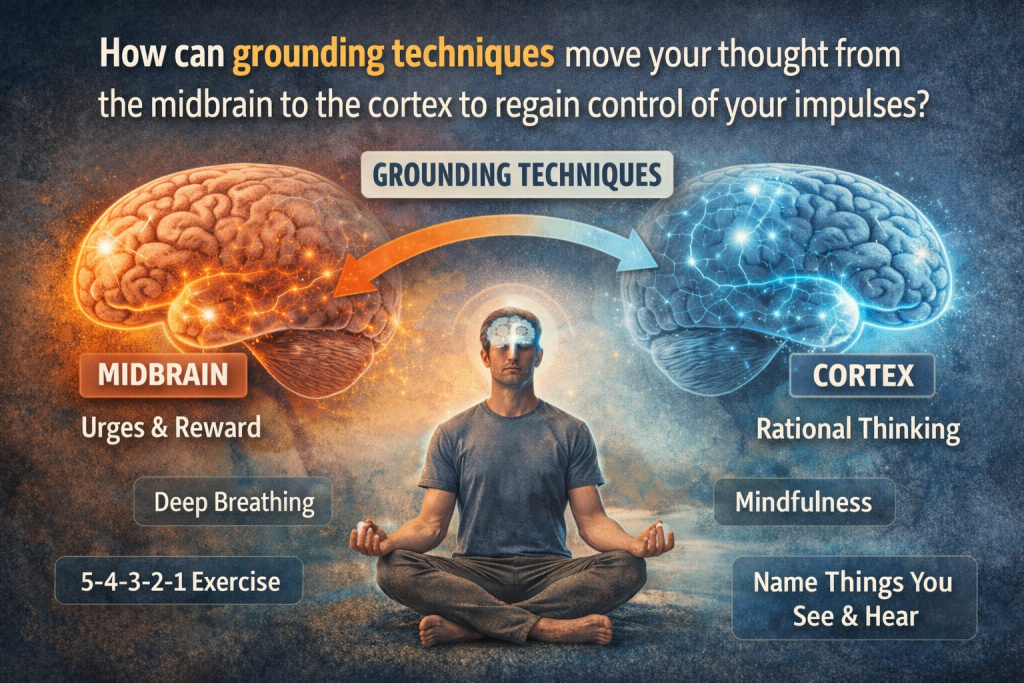 From Impulse to Control: How to Shift the Brain From Survival Mode Back to Thinking
Practical tools to move from urgency to cognition: counting, breathing, imagery, and grounding.
Why thinking shuts off in cravings, panic, and anger
In high stress, the brain prioritizes speed over reflection. Survival circuits drive behavior while executive function drops. This is a core reason risk can spike during substance use and withdrawal (see risk and cognition).
The principle: shift state first, think second
These tools are not “distractions.” They send signals of safety and orientation that bring the prefrontal cortex back online.
Counting backward (cognitive load)
Count backward from 100 by 7s (or from 50 by 3s). The working-memory demand recruits executive function and interrupts impulsive loops.
Box breathing (4-4-4-4)
Inhale 4 seconds, hold 4, exhale 4, hold 4 for 1–3 minutes. This lowers sympathetic activation and helps the body exit threat mode.
Pleasant or neutral imagery
Picture a safe or neutral scene with detail (light, temperature, sound). This competes with threat circuitry and reduces urgency.
5-4-3-2-1 grounding
- 5 things you can see
- 4 things you can feel
- 3 things you can hear
- 2 things you can smell
- 1 thing you can taste
How this fits treatment, MOUD, and harm reduction
These skills support safety in real time, but they don’t replace treatment. They pair well with an assessment-based plan (see clinical assessment), appropriate structure (see levels of care), and medications when indicated (see MOUD).
Related Reading
- Levels of Care Explained: How to Know What Kind of Help You Actually Need
- Clinical Assessment and Diagnosis of Substance Use Disorders (SUDs)
- MOUD 101: What Medication for Opioid Use Disorder Is — and Why It Saves Lives
- Risk Assessment, Cognitive Function, and Impulse Control: How Substance Use Changes Decision-Making
More Recovery Resources from Red Door
- Community Meetings Directory — Find AA, NA, SMART Recovery, Al-Anon, and Celebrate Recovery meetings
- Meetings Blog — Articles about recovery meetings and what to expect
- Peer Support Specialists — Connect with certified recovery coaches
- Harm Reduction Agencies — Naloxone, needle exchange, and overdose prevention
- Food Pantries — Free food assistance for those in need