How Addiction Hijacks Your Thinking
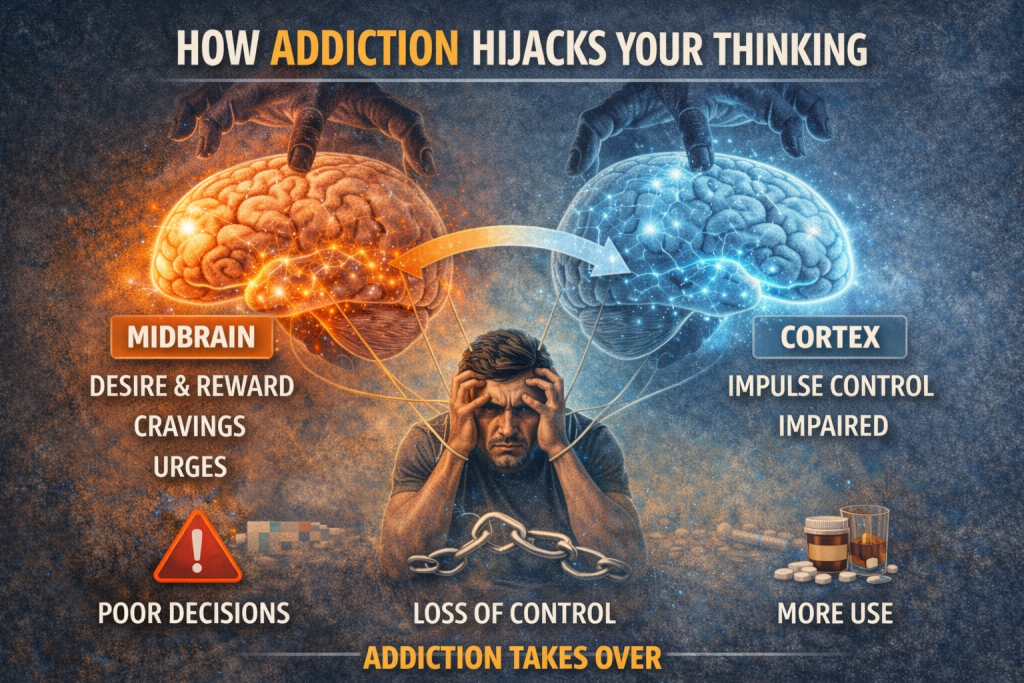 Risk Assessment, Cognitive Function, and Impulse Control: How Substance Use Changes Decision-Making
How ongoing use and stress impair risk evaluation and impulse control, and why risk must be assessed dynamically.
Risk assessment starts with how the brain makes decisions
Clinical risk assessment is not just “will this person do something dangerous?” It’s also “does this person currently have the cognitive capacity to consistently choose safety?” That capacity is evaluated during clinical assessment and influences level-of-care placement.
What changes in the brain
1) Risk evaluation
Ongoing substance use can reduce sensitivity to negative consequences and increase sensitivity to immediate relief. Risk does not disappear—it gets discounted.
2) Impulse control
Chronic use weakens inhibitory control, making it harder to delay action, resist urges, or stop once use begins.
3) Cognitive flexibility
People may struggle to shift strategies, learn from outcomes, or adapt under stress—leading to repetitive patterns that look “irrational” from the outside.
Stress makes it worse
Stress pushes the nervous system into survival mode. When someone is in withdrawal, trauma activation, or acute instability, executive function drops further. This is where immediate harm reduction can prevent catastrophe while capacity rebuilds.
Dynamic risk: why it changes week to week
Risk is dynamic, influenced by sleep, stress, recent use, tolerance changes, support, and access. Someone can be low risk one week and high risk the next depending on circumstances.
Implications for treatment
When decision-making is impaired, treatment often needs external structure: routines, accountability, safe environments, and sometimes medication. For opioid use disorder, MOUD reduces cravings and overdose risk and improves stability.
Related Reading
- Where Addiction Lives in the Brain — and Why It Can Feel Like Survival Without Substances Is Impossible
- Clinical Assessment and Diagnosis of Substance Use Disorders (SUDs)
- Levels of Care Explained: How to Know What Kind of Help You Actually Need
- MOUD 101: What Medication for Opioid Use Disorder Is — and Why It Saves Lives
More Recovery Resources from Red Door
- Community Meetings Directory — Find AA, NA, SMART Recovery, Al-Anon, and Celebrate Recovery meetings
- Meetings Blog — Articles about recovery meetings and what to expect
- Peer Support Specialists — Connect with certified recovery coaches
- Harm Reduction Agencies — Naloxone, needle exchange, and overdose prevention
- Food Pantries — Free food assistance for those in need